He Wanted a Robot.
Not a Guide Dog.
We Said Yes.
A Kid at Dana-Farber.
A Problem Nobody Had Solved.
A.D. is a kid at Dana-Farber Cancer Institute. His leukemia treatment damaged his vision. He needed a seeing-eye companion — something to help him navigate the world while he was fighting the hardest battle of his life.
The guide dog waiting list was a year long. The process was involved. And A.D. — he'll tell you himself — hates dog poop.
He wanted a robot. A dinosaur robot, specifically.
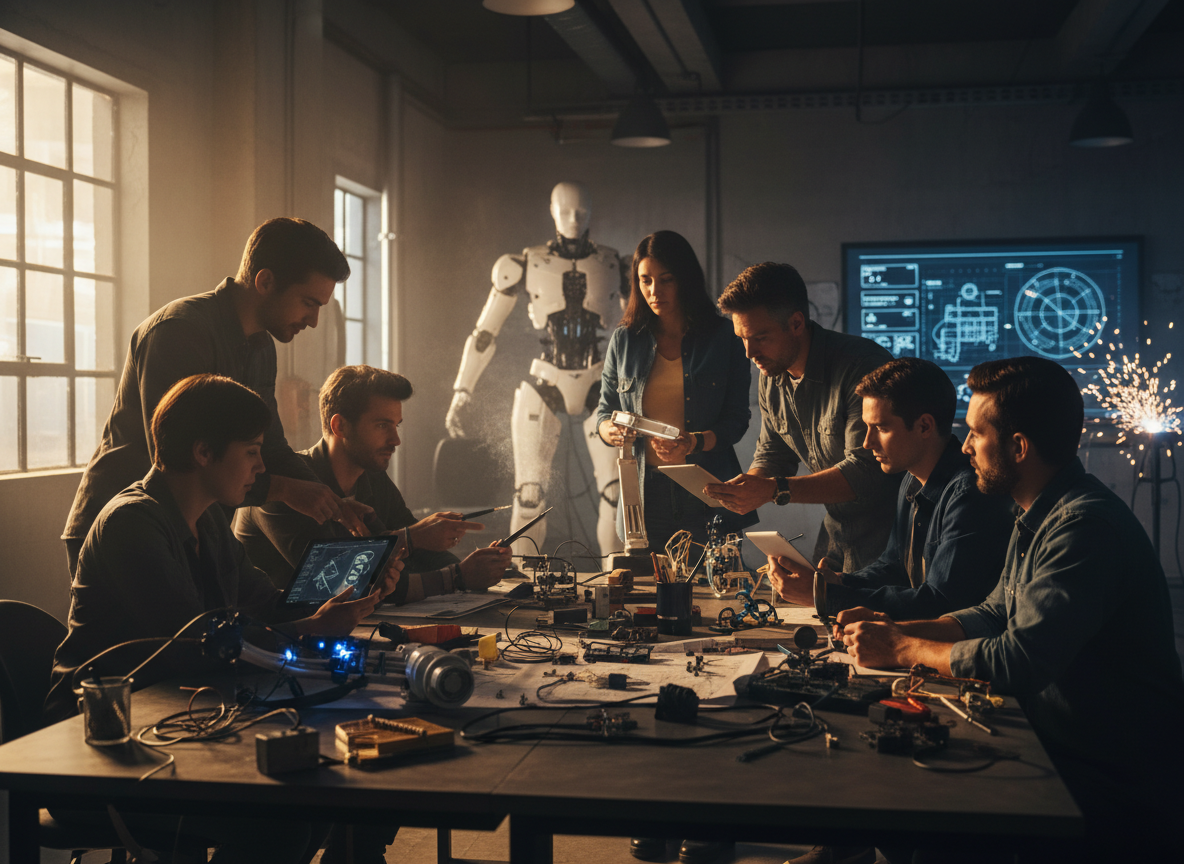
His mom called the Mad Scientist. The Mad Scientist said yes. And everything you see here — V.I.C.K.I., the Dash R-1, BuddyBots, the entire Stim Factory architecture — is what happened when a garage full of disabled makers took an 11-year-old's specifications seriously.
The System Wasn't Built
For Kids Like A.D.
A.D. needed a companion that was autonomous — not operated by a stranger watching through a camera. He needed something that worked without internet, because hospitals have HIPAA requirements that cloud robotics can't meet. He needed something that didn't require insurance approval, because the system built to provide adaptive technology was also built to limit access to it.
Every constraint A.D. had was a constraint the entire adaptive robotics industry was ignoring. Not because they didn't know. Because they weren't building for A.D. They were building for enterprise clients who could afford them.
That's not a gap in the market. That's a wall. We build on the other side of that wall.
Built by Hand. Built With Purpose.
Stim Factory was founded by Joseph “Joie” Thompson — a machinist-turned-engineer who spent years building things with his hands before he started building things with purpose.
The pivot wasn't a business decision. It was a conversation with a kid who needed a robot that didn't exist. So we built one. And in the process of figuring out how to build it right — edge-native, safe, private, affordable — we built a company.
We are disability-owned and disability-operated. That's not a credential we carry for optics. It's the reason our technology works differently than everyone else's. We build for ourselves. We build for people like A.D. And because we do, we end up building something that works better for everyone.
When Inclusivity Leads,
Innovation Follows.
Every technology that was designed for disabled users first has ended up benefiting everyone. Curb cuts were designed for wheelchair users — they're used by strollers, delivery carts, and cyclists every day. Voice recognition was designed for people who couldn't type. Closed captions were designed for the deaf — now everyone uses them in loud restaurants.
We are not building adaptive technology as a niche product. We are building the future of robotics by starting with the people everyone else forgot to design for. The result will be technology that works better, for everyone, because it had to.
The Infrastructure Came First.
The Products Follow.
Most startups build a product and figure out the company later. We did it the other way. We built the manufacturing capability, the AI architecture, the IP pipeline, the operational structure — because we knew that if we were serious about serving the communities we care about, we couldn't afford to cut corners in the foundation.
That's unconventional. It's also why we're ready to ship when others are still figuring out how to build what they promised.
Want to Join the Mission?
We're looking for investors, partners, and builders who see what this becomes.
Get In Touch